
Brick Plant Equipment List: From Raw Material Preparation to Finished Bricks

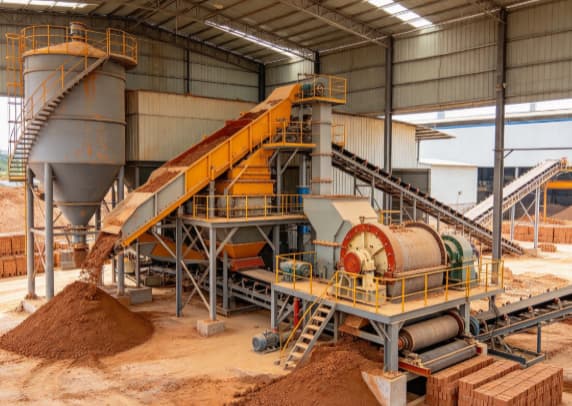
A brick plant equipment list for fired clay production normally covers material feeding, preparation, forming, drying, firing, product handling and quality checks. Concrete block and fly-ash brick plants use different process routes.
An extruder and kiln alone do not define an operating line. The useful list identifies each machine’s duty, the supporting equipment and the interfaces between stages.
Start with representative clay tests, brick drawings and saleable output requirements. Then identify which functions need dedicated machines and which can be combined or handled manually.
What Belongs on a Brick Plant Equipment List?
The following equipment schedule suits an extruded clay brick line as a starting point. Equipment selection changes with material condition, product geometry, handling strength and the chosen thermal system.
| Production stage | Typical equipment | What to verify |
|---|---|---|
| Receiving and feeding | Loader, receiving hopper, box feeder, conveyors | Feed consistency and storage-to-line interface |
| Size reduction | Primary crusher, pan mill, disintegrator or roller mills | Incoming lumps, moisture, abrasiveness and required particle size |
| Blending and conditioning | Dosing feeders, mixer, water metering, reclaim equipment | Blend repeatability and moisture distribution |
| Forming and cutting | Vacuum extruder, vacuum system, dies, column cutter and multiwire cutter | Product geometry, forming behavior and cutting accuracy |
| Green-brick handling | Transfer conveyors, grippers, setters, racks or cars | Support during transfer and compatibility with drying |
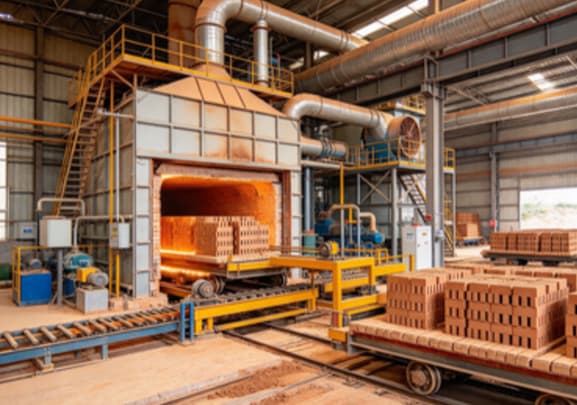
| Drying | Chamber or tunnel dryer, circulation fans, ducts and controls | Evaporation duty, loading arrangement and drying sensitivity |
| Firing and cooling | Kiln, fuel system, fans, controls and associated handling | Firing trials, fuel compatibility and product movement |
| Unloading and packing | Unloading station, sorting area, strapping or palletizing equipment, forklifts | Pack format, unloading rate and dispatch needs |
| Inspection and testing | Scales, dimensional tools and appropriate laboratory equipment | Required tests and division between in-house and external testing |
The Brick Industry Association’s manufacturing guide explains the underlying preparation, forming, drying and firing stages. Use the table as a functional checklist rather than a requirement to purchase every listed machine.
For example, alternative preparation machines do not automatically belong in the same line. Select them around the material treatment required, not around the length of the equipment schedule.
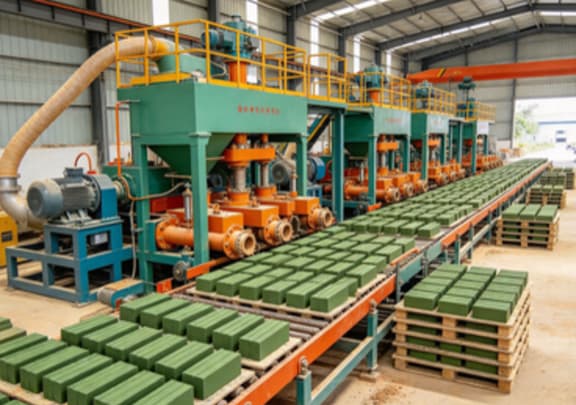
Why Raw Materials and Drying Change the Machine Selection
Match preparation equipment to the actual clay
Wet, plastic clay and dry, hard shale respond differently to grinding. A preparation circuit that works for one deposit may be unsuitable for another.
Verdés’ wet clay processing documentation identifies moisture and abrasiveness among the factors affecting grinding equipment selection. It also describes roller milling as a subsequent refining step. Verdés
Before choosing the preparation circuit, compare:
- Incoming lump size and seasonal moisture variation.
- Stone, carbonate or other inclusion content.
- Required particle-size distribution for the intended product.
- Wear-part access, replacement frequency and local service capability.
Do not specify the finest available mill setting by default. Establish the preparation requirement through trials, then assess throughput, wear and power demand against that target.
Choose handling and drying together
The dryer determines more than the heat supply. Its loading method affects racks, carriers, transfer stations, setting equipment and empty-car return arrangements.
The Brick Development Association’s brickmaking guide describes chamber, tunnel and kiln-car drying. Direct setting onto kiln cars is applicable only where the green product and material behavior support it. brick.org.uk
Ask for drying capacity in terms of both product loading and water evaporation. Piece counts alone cannot establish whether a dryer can process a wetter or heavier product.
Equipment Selection for Solid and Hollow Clay Bricks
Solid and hollow products can share parts of a production line, but their tooling, support and thermal requirements need separate checks.
| Selection point | Solid bricks | Hollow bricks or blocks |
|---|---|---|
| Extrusion tooling | Die matched to section and shrinkage allowance | Die and core arrangement matched to webs and voids |
| Green handling | Check unit weight, surface marking and deformation | Check web damage and gripper contact positions |
| Drying | Validate moisture removal through the body | Validate airflow, geometry and shrinkage behavior |
| Setting and packing | Confirm load stability and pack weight | Confirm orientation, support and resistance to handling damage |
Review each proposed format with drawings and samples. A machine’s advertised brick-per-hour rating may refer to a different size, void ratio or forming condition.
For capacity matching, convert every stage to a common production basis. Distinguish wet feed tonnes, green units, fired tonnes and accepted finished bricks.
Suppose the target is 120,000 accepted bricks daily, with an assumed 96% overall saleable yield. Approximately 125,000 formed units would be required.
If forming operates for 16 productive hours, the average requirement is about 7,813 units per hour. These illustrative assumptions exclude additional downtime and changeover allowances.
Check whether drying, firing, unloading and packing support that daily requirement under their own operating schedules. A larger extruder cannot resolve an undersized dryer.
Check Auxiliary Systems and Kiln Package Boundaries
A practical brick plant equipment list includes supporting systems alongside the main machines. Use the following items to review the proposed scope:
- Material transfers: Conveyor drives, chutes, sensors, transfer heights and reject-return equipment.
- Electrical and controls: Motor control centers, drives, field wiring, interlocks and production records.
- Utilities: Vacuum pumps, compressed air, water dosing and fuel preparation where required.
- Environmental systems: Dust extraction and flue-gas treatment selected for the raw materials, fuel and applicable requirements.
- Maintenance: Lifting access, lubrication equipment, wear parts, spare cutting wires and product-specific tooling.
Identify an owner for each connection between equipment packages. A conveyor supplied by one party must still match the next machine’s elevation, capacity and control signals.
For commercial scope comparisons, seeBrick Production Line Cost: Equipment and Capacity Factors.
Include the equipment needed to verify finished bricks
Routine checks may require scales, dimensional gauges and moisture-testing equipment. Strength and absorption testing may be performed internally or by an appropriate external laboratory.
ASTM C67/C67M provides methods for brick testing, including compressive strength, absorption, dimensions and warpage. It is a test-method standard; product acceptance limits come from the applicable specification. store.astm.org
Match the kiln configuration to the rest of the line
Yaxin’s Prefabricated Tunnel Kiln page describes modular construction, kiln-car tracks, drying arrangements and digital firing control. Confirm which fans, cars, transfers and controls belong to the proposed package. prefabricated tunnel kiln
The Mobile Rotary Tunnel Kiln page describes a moving kiln body on circular rails with connected drying and firing sections. Its handling interfaces differ from a conventional kiln-car line. rotary kiln manufacturer
Compare the full process configuration before selecting the thermal system. A kiln product description does not establish that preparation, extrusion, packing and all auxiliary equipment are included.
FAQ
Does every clay brick plant need a vacuum extruder?
No. Vacuum extrusion is one forming route; molded and dry-pressed clay bricks use different forming equipment. Confirm the product and material route first.
Can one line produce both solid and hollow bricks?
Potentially, with compatible tooling, handling, drying and firing arrangements. Check each product’s demonstrated output rather than assuming one rated capacity applies to every format.
When is automatic stacking worth considering?
Compare handling labor, product damage, operating consistency and maintenance demands. Automation is more useful when it addresses a measured production constraint and suits the green product.