
Clay Brick Production Process: From Raw Material to Firing

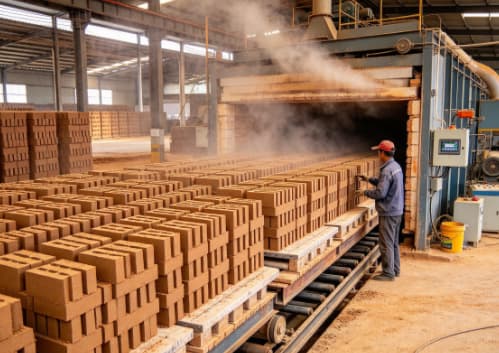
The clay brick production process connects several operations that need to be planned as one line. Raw material is prepared, shaped, dried, fired and checked before dispatch. The exact sequence and equipment depend on clay behavior, product geometry, output target and local practice, so a process map should be confirmed with representative material tests. The clay brick production process is best planned as a connected route, with an acceptance check at each handover.
1. Raw-material preparation
Clay or blended material is excavated, stored and prepared to reduce large lumps and control particle size. Crushing, screening, aging, mixing and water addition may be used to achieve a workable and repeatable body. A stable feed makes forming easier, but different clays can respond differently to moisture, mixing and storage time.
2. Forming and cutting
Prepared clay is shaped by extrusion, pressing or another method suited to the product. In an extruded line, a vacuum pugmill or extruder may compact the body before it passes through a die; a cutter then creates the required length. Operators check dimensions and surface condition before the green units move to drying.
3. Drying before firing
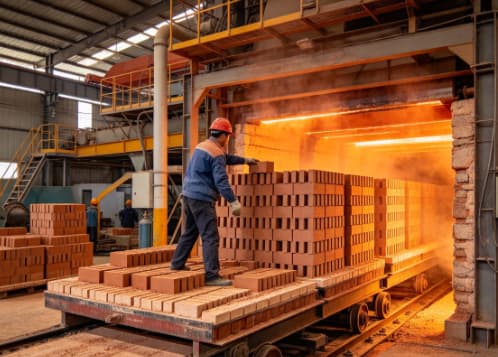
Freshly formed bricks contain water that must be removed at a controlled rate. Early drying involves shrinkage, so uneven airflow or moisture can cause cracks and distortion. Later drying removes remaining moisture with less dimensional change. Dryer settings need to reflect the body, green-brick arrangement, climate and production rate. The UNIDO small-scale brickmaking reference explains raw-material, shaping, drying, firing and factory-organization considerations, although each plant should use current local testing and engineering data.
4. Firing and cooling
The dried units enter the kiln under a defined temperature and atmosphere profile. Firing changes the clay body’s structure and develops the required properties. In a continuous kiln, product moves through preheating, firing and cooling zones; the kiln design and loading pattern shape heat transfer. TheYaxin rotary kiln pagedescribes its mobile rotary tunnel kiln sections as drying/moisture removal, preheating, burning, and insulation/cooling. Treat that as a supplier description of its configuration, not a universal kiln layout.
Cooling also requires process control. Rapid or uneven temperature change can damage some products, while effective heat recovery may support drying or other plant uses. Review the full thermal circuit rather than considering firing in isolation.
5. Inspection and dispatch
After cooling, finished bricks are sorted, sampled, tested, stacked and packaged. Product inspection may include dimensions, appearance, strength or absorption depending on the specification and market. ASTM’s C67/C67M testing methods describe several brick and structural clay tile tests; select methods that apply to the product and contract.
A process map is most useful when each step shows its input, output, target rate and quality check. That reveals whether preparation, forming, drying, firing or handling is likely to constrain saleable production. For equipment planning, see therotary kiln product pageand theindustry knowledge library.Documenting the clay brick production process helps teams trace a quality change to its earliest stage.
What are the main steps in clay brick manufacturing?
Raw-material preparation, forming, drying, firing, cooling, inspection and packaging are the core stages. Equipment and controls vary by product and production scale.
Why is drying important before brick firing?
Drying reduces moisture before high-temperature firing. Uneven moisture removal can contribute to cracking and distortion, so the drying schedule should match the clay body and loading pattern.
Follow the product through the full process route
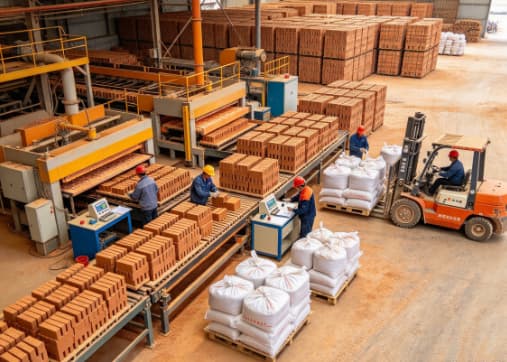
Show how material moves between stages and where it is sampled. At receipt, confirm material source and variability. Preparation adjusts particle size, blend and moisture for forming. Forming establishes geometry and green strength; cutting and handling should preserve shape. Drying removes moisture before firing, while the kiln develops the required fired properties through heating and cooling. Sorting and testing determine whether the product meets its specification.
Each transition needs an acceptance check. A material change may require a forming or drying trial; a new product size may need revised tooling and stacking; and a kiln schedule change should be checked against measured properties. Keep representative samples from each stage so a defect can be traced to where it first appears. This helps separate raw-material issues from dryer or firing issues.
A plant flowchart can name the process owner, control point, record and response at each stage. If green-brick moisture is outside its working range, for example, operators should know whether to adjust drying, reduce feed or hold a batch for review. Determine the correct response through local trials rather than copying generic settings.
What is the most important stage?
No stage determines quality by itself. Consistency comes from matching preparation, forming, drying, firing and handling to the product specification, then using test results to correct variation.